

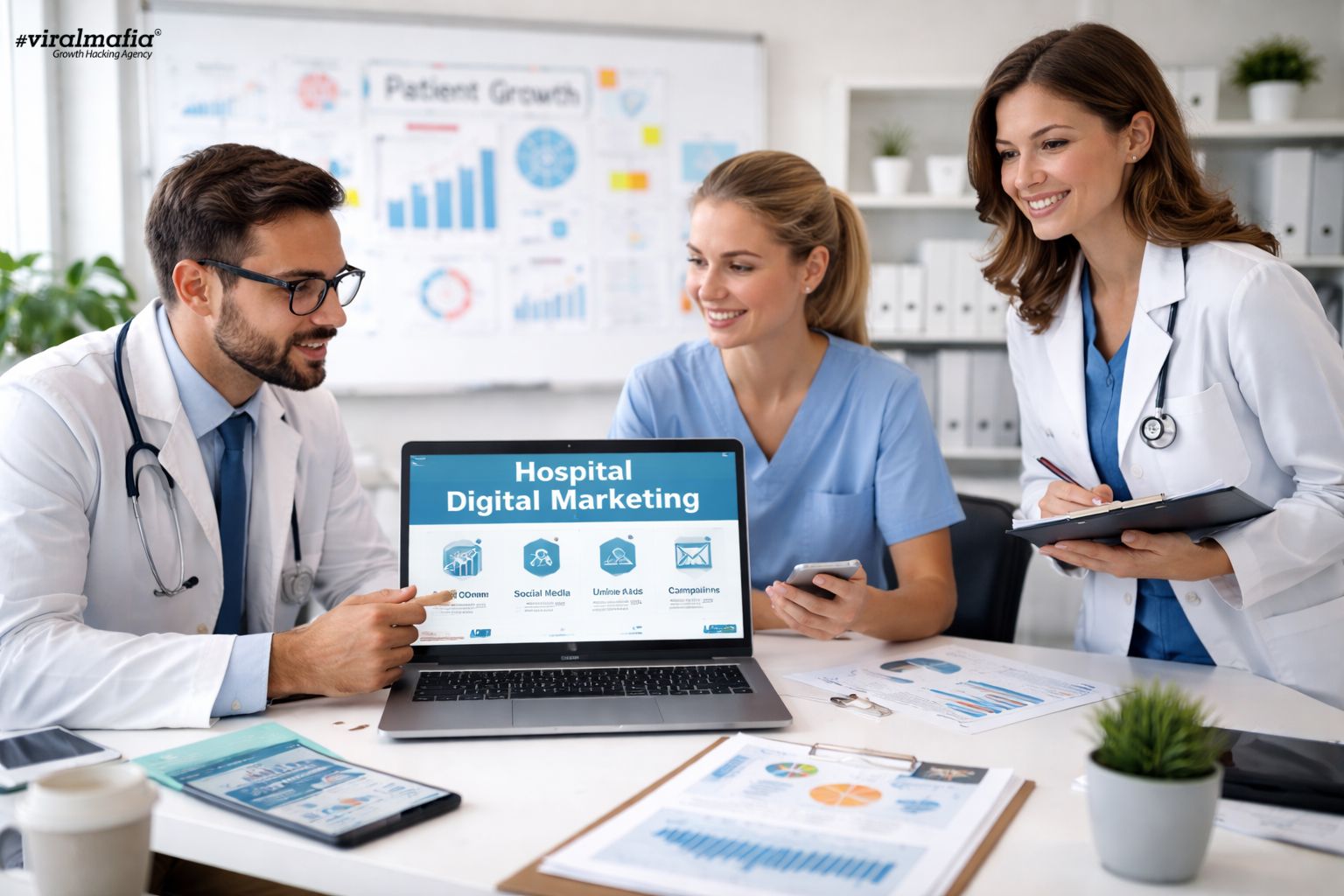
‘The best doctor near me’ is most likely the keyword a patient search before visiting a particular doctor. Google provides them with the doctor’s details, the hospital or clinic’s facilities, testimonials and reviews, all of it with just a tap of the fingertip. Healthcare providers who keep their websites and customer support systems up to date are more likely to gain attention, while others risk falling behind without effective results.
According to recent studies, there is an increase in the number of users who search before engaging with any kind of services. And that’s why digital marketing is no longer just an option for hospitals and healthcare providers, it’s becoming a necessity. What type of approach will help you in scaling up your digital presence? As an experienced and reputed digital marketing agency in Kerala, we can help you sort out things that help you in solidifying your digital base.
1. Local SEO – The Inevitable Part
When an individual search for “cardiologist near me” or “urgent care opens now,” it indicates they are not just browsing but they are in need of that service. Being there at that exact second is far more valuable than setting couple of advertisement hoardings on the street. Local SEO is built to capitalize on these kinds of search queries.
Begin by optimizing your Google Business Profile. Your GBP must be comprehensive, accurate, and maintained. Images, current hours, responding to reviews, and categorizing services properly, these contribute to your ranking on Google’s local results page. As an experienced SEO agency in Kerala, we have partnered with numerous healthcare providers to strengthen and scale their digital presence using tailored SEO strategies. Practices that treat their GBP actively, not as a set and forget listing, consistently outperform those that don’t. Apart from GBP, Local SEO focus on creating service specific landing pages, getting citations from credible directories and obtaining backlinks from local news websites or local community websites. It would be best to consider using schema markup, which is a form of structured data that will allow search engines to understand what your business does.
2. Building Trust & Credibility – Reputation Management
Hospitals heavily invest in its advertising efforts, yet if the first listing in Google shows a 3-star rating, the money spent is more or less wasted. Online reputation is not an intangible concept anymore; it is a straight conversion tool. Ninety percent of patients rely on online reviews when deciding on medical care. Almost half would be willing to pay out-of-network for a service provider with top reviews. This is important because a powerful testimonial from one client can do more for your reputation than any other marketing material used.
Answer every review, both the good and bad. By responding to negative feedback professionally and with empathy, you show future patients that you’re responsible. If you ignore negative reviews, users will have a feeling that you are ignoring it and are not willing to change and improve, of course, it will create a negative impression.
3. Build Authority Before the Patient Knows You
The majority of individuals who will be your clients at the end of the day would be already looking for health-related data well before they even require a procedure or consultation from you. By doing content marketing, you can connect with people while they are in search mode and when they think of booking their appointment, your ‘name’ would already be the trusted entity in their minds.
Healthcare blogs can drive up the amount of organic traffic to your website by 50–100%. It has been shown that practices that engage in patient education through content marketing have significantly higher retention rates than others. There is a good reason for this trend. Writing better, writing informational content, however, is always more important than just writing more, everywhere quality matters more than quantity. Google’s algorithm, which prioritizes experience, expertise, authoritativeness, and trustworthiness (E-E-A-T), gives emphasis on healthcare-related content that is written by certain trusted authors & sources. Google has been very strict in targeting unhelpful medical content since its helpful content update. Try to Include –
- Patient condition explainers from your physicians
- FAQ sections covering the typical pre-appointment questions
- Guidance on procedures and real recovery expectations
- Video content including patient reviews
- Health advice for different seasons based on search intent (flu season tips, summer heat warnings, etc.)
4. Paid Advertising – A Quick Approach
Organic SEO generates sustainable value. Google and Meta pay-per-click advertising provide patients immediately. In cases of market competition, or if the practice belongs to an area of high-demand specialties, such as cosmetic surgery, orthopedics, or fertility services, pay-per-click is a much faster and more effective way to implement. For hospitals and medical centers, pay-per-click campaigns achieve conversion rates up to 12 %—one of the best in any industry. On average, the cost per lead in the healthcare industry is around 25-50 $, but it varies greatly by specialty. Pay-per-click leads for cosmetic surgery can be as expensive as $100+ per lead, whereas urgent care and primary care are much lower.
Remarketing is yet another untapped resource within healthcare PPC campaigns. If your patient goes to your orthopedic surgery website but fails to convert, a carefully selected banner ad pops up at precisely the correct time.
5. Social Media Presence
Social media marketing in healthcare is not a matter of going viral; rather, it is being consistently present in the social circles where the target audience is engaged through the use of valuable information. Healthcare organizations engaging with their audience via social media are seen 3–7x more trusted by patients compared to their competitors with no online presence at all. Informational posts receive far more attention than the promotional ones. The channels carrying most of the weightage is currently Facebook (mostly among age group of 30-65), Instagram reels, and LinkedIn (for professional networking within the B2B sector). Partnering with an experienced social media marketing agency in Kerala will ease your work while scaling up your social media presence.
Genuine patient testimonials remain one of the best sources of information. Authentic stories with actual results are much more effective than any sponsored advertisement. Moreover, adding behind-the-scenes videos, employee features, and health tips to your social activities is a sure shot strategy for success.
6. Hassle-free Website Experience
Everyone else will eventually funnel into your website somehow. Should that visit fail because of slow loading time, confusing appointment booking buttons, or a lack of mobile optimization, then you’ve just failed to secure a potential patient who was looking for you.
On average, patients compare 3-5 different websites before making their choice. Websites with less than 2 second load times have conversions that are 47% higher than their counterparts. Bounce rates for healthcare sites are consistently around 52-67%. This means that failing at that crucial first interaction means immediate loss of potential revenue. Campaign landing pages, not just homepages, can dramatically improve conversion. It only makes sense that a patient clicking on an ad for “treatment for knee pain” would be taken to a page about knee pain, rather than your home page. Pages that display price details have a 19% improvement in conversion rates.
Getting into The Bigger Picture with Viral Mafia
Digital marketing in healthcare is not about following trends; it is about creating consistent visibility in the spaces where the decisions are being made with a strong focus on earning trust. SEO creates discoverability. Reputation management turns those views into patients. Content establishes authority before meeting the patient. Paid advertising fills in gaps, and the website delivers it all seamlessly. This approach is more than just leveraging separate channels. The most effective digital marketers are the organizations that are integrating their approach to create true effective ecosystems. Focus on local SEO and reputation management first; it will make a difference in the span of 60-90 days. From there, expand outwards.
Want to learn from a company specializing in creating systems for healthcare organizations? The Viral Mafia helps healthcare organizations develop digital marketing strategies with impact, not vague but solid strategies, we provide the best.
